
How AI Is Rewriting Business Intelligence
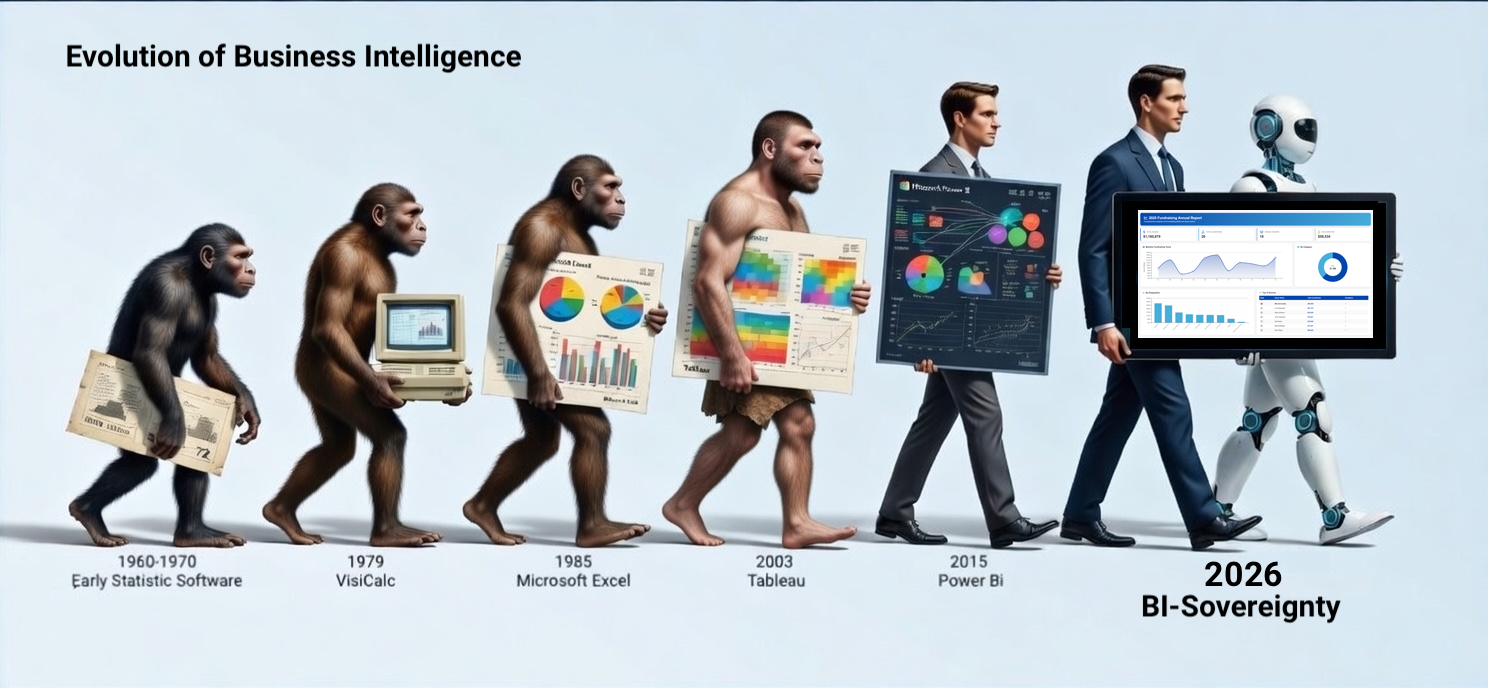
For decades, business intelligence followed a predictable path. Spreadsheets gave way to expensive dashboard platforms. Those platforms moved to the cloud, locked behind per-seat licenses, capacity charges, and vendor roadmaps. Organizations paid handsomely for the privilege of seeing their own data—while often surrendering control over definitions, access, and the systems that turned numbers into decisions.
That model is now under pressure.
Modern AI has made it practical to generate sophisticated reports, narratives, anomaly detection, and exploratory analysis without relying on the old licensing machines. Natural-language queries, automated insight generation, and governed analytical pipelines can now run on infrastructure an organization actually controls. The result is not just lower cost. It is the recovery of ownership over the intelligence layer itself.
Open-source language models play a decisive role. When analysis happens inside a private environment—on models that never send proprietary data to external endpoints—the security and sovereignty equation changes. Sensitive context stays inside the perimeter. Metric definitions remain under internal governance. The organization decides how AI participates, rather than accepting whatever the vendor’s latest feature release allows.
This is the emerging reality of BI Sovereignty: the ability to produce trusted, explainable business insight without renting the underlying intelligence from a third party. Legacy tools still have their place for certain visualization or collaboration needs, but the economic and strategic case for total dependence has weakened. Companies that once felt trapped by licensing and data-flow constraints now have a viable alternative path—one that prioritizes control, security, and long-term cost discipline.
The progression is no longer theoretical. Static reports became dashboards. Dashboards became expensive cloud subscriptions. Cloud subscriptions became quiet dependency.
BI Sovereignty is the break in that chain. It is the decision to stop renting the intelligence that runs the business and start owning it—on your terms, inside your boundaries, with models and rules you control.
The tools have finally caughtup. The only remaining question is if and when leadership will decide to make the pivot !